It goes without saying, but golf is expensive. And the newest drivers on the market will run you north of $650, with the new Titleist GTS lineup starting at a cool $700.
Needless to say, not everyone can afford to buy the latest and maybe greatest driver there is.
But what if I said you could buy one of the best drivers out there, from a name brand, still new and in the wrapper, and allows for loft and lie adjustments that just about anyone can dial in, for just $300?
Enter the Cobra DS Adapt lineup.
At any major retailer and on the Cobra website, the DS Adapt lineup is $300 thanks to it being a year old and plenty of stock laying around that they are trying to move. Again, a brand new, with plenty of good stock shaft options for you to choose from, in the wrapper, from a known brand, driver for $300.
This lineup caught my eye earlier this summer because the folks at Golf Digest did a comparison of the last three years of Cobra drivers, and found that the DS Adapt lineup, released in 2025, was head and shoulders above the DarkSpeed (2024) and OPTM (2026) releases in terms of distance, forgiveness, and ball speed on mishits.
In My Golf Spy’s testing in 2025, three of the four DS Adapt drivers were among the Top-16 out of 37 tested. To put it short, more than one outlet has proven they are good drivers. And again, they are $300.
Aside from the price, I was drawn to the DS Adapt lineup because my driver (Stealth 2+ Tour Issue Asterisk) had failed me this year. It is the longest driver I’ve ever hit, but the wayward balls and mishits had gotten to where I stepped to the tee and had no confidence over the ball, and knew I needed to make a change that wasn’t just, “Hit driving iron off every tee.”
I opted for the standard DS Adapt X, the model that should fit the majority of golfers, in a 10.5 loft, and with a Project X Denali Blue stiff shaft.
After a pair of indoor range sessions on my home simulator and an outdoor round, here’s my takeaway on the DS Adapt X.
First Impressions
The DS Adapt X is a sharp driver. There’s nothing flashy going on, but the pops of blue on the bottom, the carbon pieces, and the weights make it look modern without looking over the top.
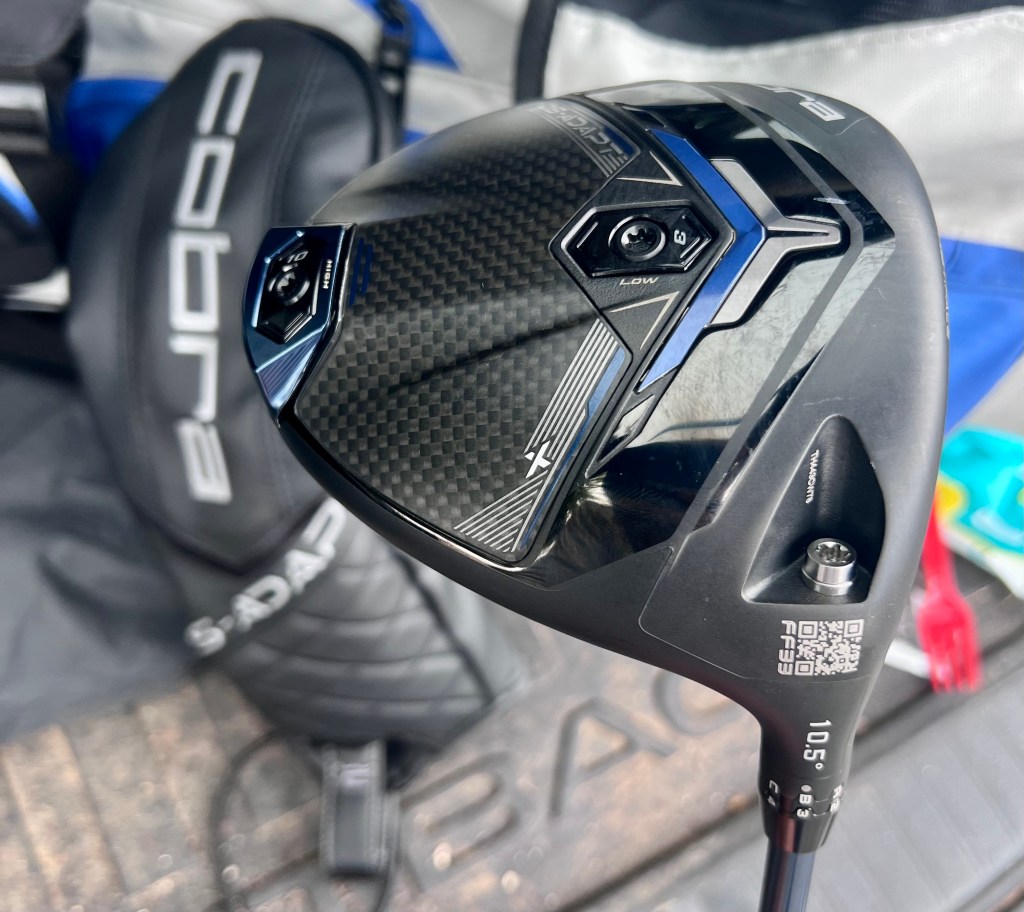
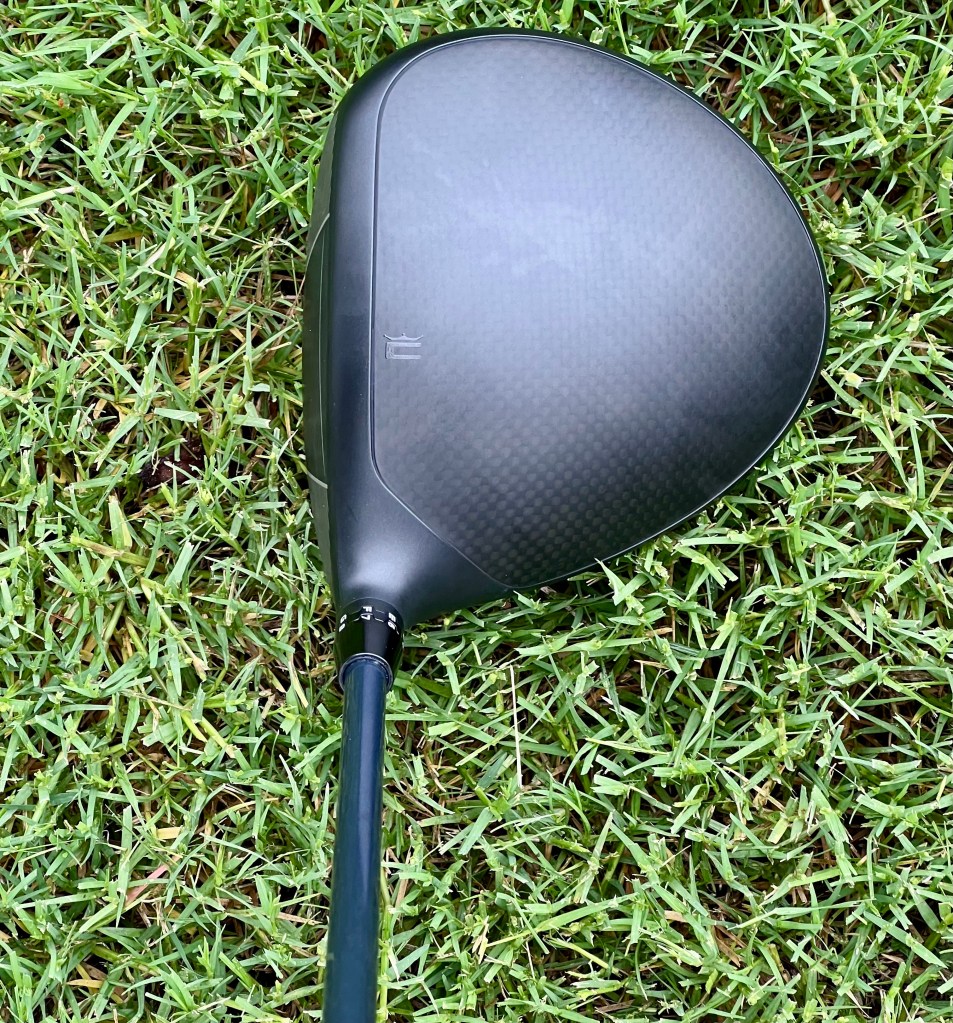
Flipping the club over, and at first impression it looks and feel a little large, but that could just be me coming from a more classic shaped driver. The top is like the bottom, there’s nothing flashy, there’s a matte carbon crown, and the Cobra logo as your alignment aid looking down. Just a clean and simple look at address that won’t distract you while you focus on the task at hand.
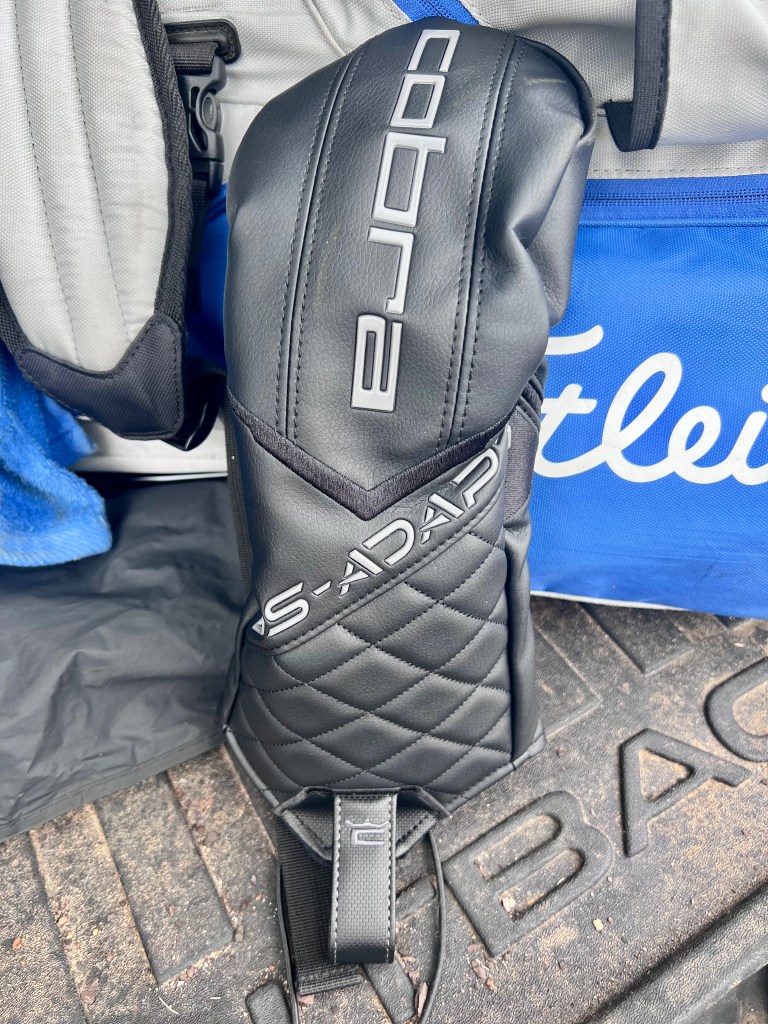
Included is a very nice headcover, with a quilted pattern on the bottom, the Cobra name, DS Adapt font, and the nod to the Future Fit 33 (more on this below) hosel on the back side of it. It’s a nice headcover, and if you’re someone who uses the stock headcover rather than something you bought, this looks nice in the bag. My only minor gripe: No matter if you buy the X, LS, Max K, or D, it’s the same headcover, so there’s nothing while in the bag that shows what one you have underneath it.
Long story short, it’s a clean looking driver that should appeal to a wide range of people.
Indoor Testing
My goal in getting the DS Adapt X was to tighten up my dispersion, while not giving up too much distance compared to my Stealth 2+.
Here’s where that Future Fit 33 hosel comes into play. Out of the wrapper, the driver is set in the A1 position, the standard loft and lie for Cobra and your driver. What you’re then supposed to do is hit 5-10 balls in that A1 setting, go to this page on the Cobra website (there’s a QR code on the driver that will take you here), tap the spot on the map of what and where your ball flight was during those hits in standard setting, and then it spits out three settings to try in hopes of straightening out your shot. There are 33 total settings, thus the Future Fit 33 name.
For me, after hitting 8 of 10 balls left of the center line, with a draw to a hook, and to my eyes flying a little high (the white lines and circle below) it suggested the B3 setting (orange lines and circles), dropping a little bit of loft, and making the driver sit a little bit flatter in hopes of forcing the ball a little bit right and minimizing my traditional left miss.
The first batch of indoor testing was done using TP5x balls.
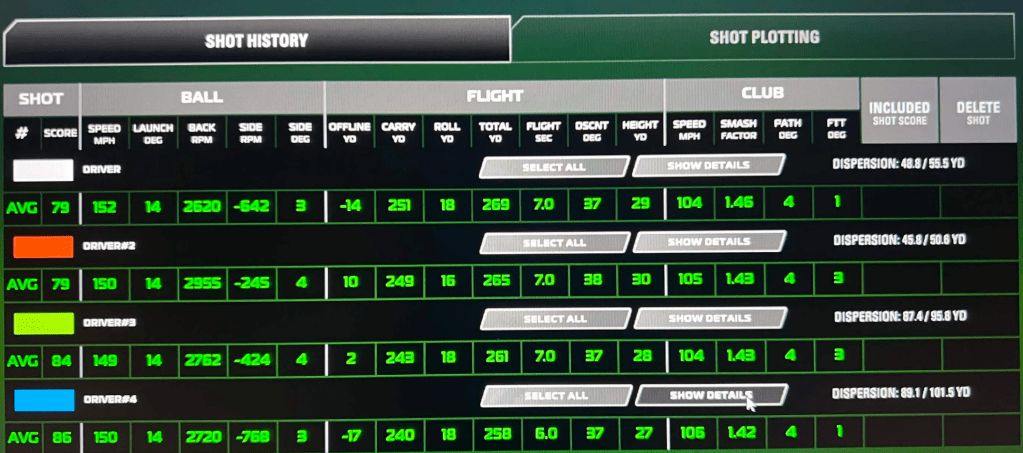
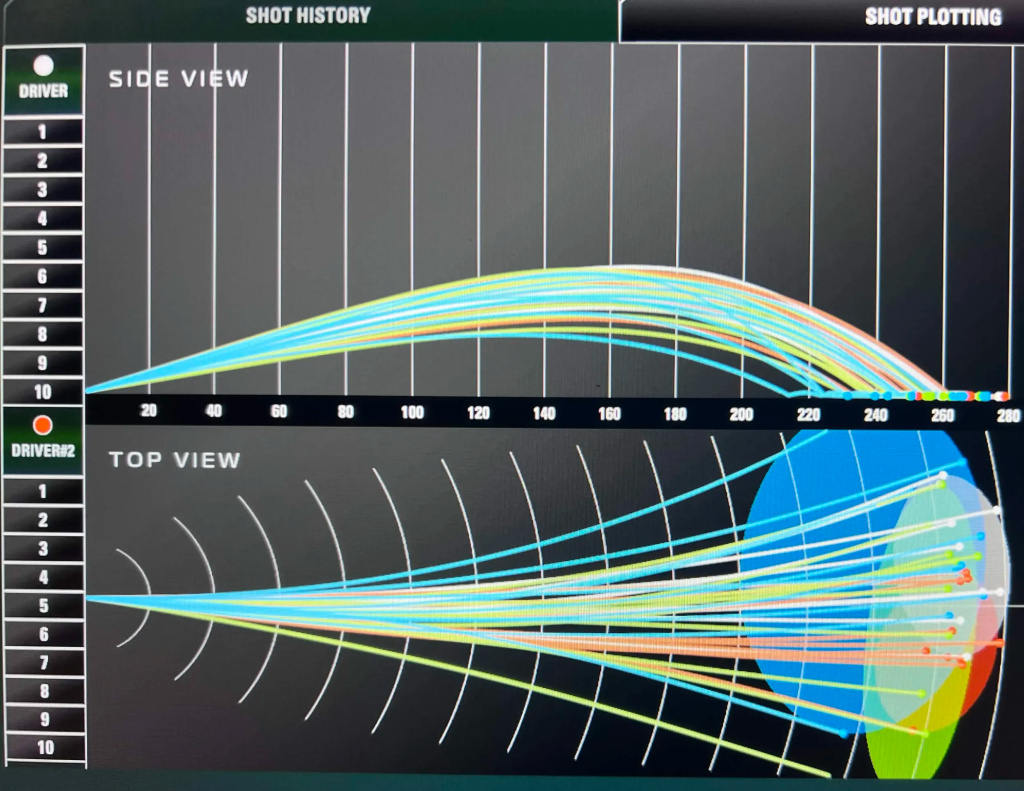
As you can see in the charts, it instantly fixed my miss, tightened up dispersion other than one wayward ball out to the right, and lost all of one yard of carry that could be blamed on that lone wayward one. On the SkyTrak driving range, there are yardage signs roughly 20 yards off the center line, roughly a 40 yard area I try to land it, and with the B3 setting, I think every single one of my shots in testing but that one landed inside that hypothetical landing area where it would either be fairway, or just in the rough on a real course.
A second test in the B3 setting but with a lower spinning ball (ProV1) dropped spin to around 2,450 and we were dialed in. We had found more forgiveness, fixed our miss, and only lost about 5-8 yards of carry compared to the Stealth 2+, in other words, it did exactly what I wanted it to.
If you STILL need more tinkering than that, you can flip the included weights, moving the 10g to the front, the 3g to the back, and creating an even lower spinning driver. Again, in some way, you or a certified fitter SHOULD be able to find a setting that works for you and your swing with this driver.
On the Course
Hitting some good shots and getting the data in an enclosed environment is all well and good, but you want to make sure a club performs when it matters during a real round.
Out of 11 attempts with the DS Adapt X, I found the fairway three times. But the driver did exactly what I wanted it to, the misses were almost entirely my fault, and I came away even more impressed than I did after the indoor range sessions. Let me explain.
I mentioned earlier that my miss is a draw that can morph into a hook at times. I spent the entire Front 9 in my round aiming down the right side not trusting that the DS Adapt X and my home fitting into the B3 setting would actually fix my usual miss on the course. So every driver on the front nine was a miss to the right, dead on-line where I was aiming. I kept missing because of my own stubbornness and refusal to think the driver had helped mitigate my usual problem.
Once we got to the Back 9 I adjusted, and the magic happened. Hole 11 at this particular course I played is a bear. It plays around 430 yards, requires you to navigate a narrow chute off the tee, and plays to a landing area that is MAYBE 35 yards wide, tree-lined on both sides. Needless to say, you have to hit driver, and you have to hit it straight.
290 yards later and on the center stripe I was in awe. It was legitimately one of the best drives I’ve ever hit in my life, and left me around 140 yards and a pitching wedge in. Four holes later, I played a driveable Par 4 that measured 297 yards, with the wind in and off the left a little bit. This time it was 282 yards, on the right side of the fairway, and an easy little pitch onto the green. Hole 18 measured around 370 yards on this particular day, and the closer to the hole you get, the narrower the shot becomes. Once again, right in the middle, and 288 yards total.
Back to those misses on the front, and this is where the DS Adapt X pleasantly surprised me. In the indoor testing above, it did exactly what I wanted, around 250 yards of carry, 265 total. Exactly what I was hoping for. Outside I measured drives of 290, 288, and 282. Not counting balls that hit trees and slow them down, I had other drives that were around 270 yards after my first swing of the day, a 280 miss right, a solid drive into the wind just in the rough that was around 260 yards, and another miss right that was around 280 yards.
Maybe it was the warmer temps (low to mid 80s and a little humid) but outside and using a ProV1, it felt like the DS Adapt X had way more pop than it was showing indoors, and was suddenly measuring up with the Stealth 2+ in terms of distance, while again, straightening out my ball flight and leading to a tighter dispersion. If I had just trusted that the driver was going to do what it was designed to do, it might have been an all-time driving day rather than missing to the right over and over.
Sound and Feel
One thing that was also an adjustment coming from a carbon face, was just how muted the sound was at impact. In my first range session in my garage, it seemed a little loud, but it’s hard to tell in such an inclosed area with tons of sound refraction.
The second session in a larger indoor setting really revealed just how quiet it was off the face.
If you made me try and describe it, it’s just quick little WHACK, and that’s it. Doesn’t ring out, it’s not loud, it’s not like the distinct CRACK that some drivers have sort of like a baseball bat. Just quick punchy, WHACK. And that’s it. Not a bad thing by any means, but oddly does give the perception that it isn’t as long or as hot, even though the outdoor round proved otherwise.
As far as feel, going back to the baseball bat analogy, and guys who have used wooden bats will know this feeling, when you middle one, it feels like you didn’t even hit a ball. It’s as if the ball just melts into the face, and then goes flying out there. It’s really an awesome feel.
Mishits are also easy to identify, you will feel it in your hands and on the clubface when you hit one out of the toe or in the heel, so you get plenty of feedback, won’t be thinking that you middled one, and left confused if it suddenly goes where you didn’t think it would.
Final Thoughts
If you made me sum up the DS Adapt X with one word, it would be consistent.
Distances on the simulator and on the course were consistent. Dispersion in both environments was incredibly consistent.
It’s about the highest praise I can give a driver. You aren’t going to lose 20+ yards unless you BADLY misshit one, and you aren’t going to go 40+ yards offline unless something in your swing sequence goes horribly wrong.
The DS Adapt X is exactly what it’s billed as, the Cobra driver that is going to fit the largest range of golfers. Is it the longest driver I’ve ever hit? No, but it is plenty long. Is it the straightest driver I’ve ever hit? No, but it was pretty darn straight, and when you combine that with distance that was nearly matching up with a LS-style driver designed to maximize distance, you have a great combination.
Throw in a hosel fitting system that anyone with access to a driving range can use to try and dial in their settings after hitting 5-10 balls, and you have a driver that will wow you right out of the wrapper, as well as one you can grow or change into if you go through a swing overhaul.
On the whole, it is just a massively impressive driver.
And did I mention you can get one new for just $300?
 Regular Golf Club
Leave a comment