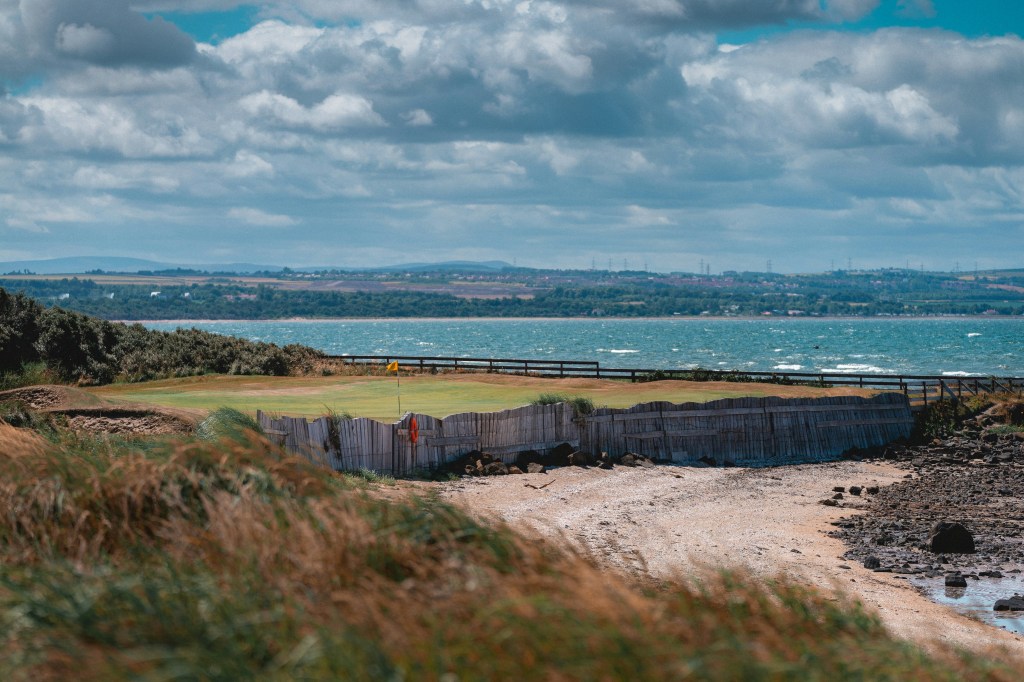
July is for the links enthusiasts
by Kyle P. (The Heather Hacker)
An Ode to Links Golf
As I woke up last Thursday and turned on coverage of the Scottish Open, I was reminded why I love golf and particularly links golf. With the Scottish Open and The Open, these two weeks in the professional golf schedule are my absolute favorite.
If you watch coverage this week, you will undoubtedly be inundated with a tagline of “forged by nature.” It’s a bit corny, but ultimately this is what sets true links golf apart from the over-manicured turf we are used to seeing week in and week out on the PGA Tour. Don’t get me wrong, I thoroughly enjoy the invites I get to my local country club where barely a blade of grass is out of place. But ultimately, that’s unnatural and often a waste of local resources while adding pesticides to the local water supply.
The minimalism of true links golf really resonates with me. The idea that some of the most heralded courses around the world were developed with no power tools and minimal earth moved speaks to the value of the land and the course designer’s vision. I was lucky enough to travel to Scotland 15 years ago and experience links golf firsthand. My last name, Peebles, is Scottish, and we traced our family back to the town of Peebles, an hour south of Edinburgh.
My family decided to go see where our family came from and, of course, play some golf. We started our adventure at St. Andrews, the birthplace of golf. We began at the Jubilee course, which is on the same land as the Old Course and New Course and the closest course to St. Andrews Bay. I could not have asked for a better introduction to links golf. Every hole was lined with gorse bushes and mounding that made every hole seem like its own separate journey. The turf was several shades of brown and yellow, not vibrant green but felt more alive than anything I have ever experienced.
Playing the Old Course was truly an emotional and transcendent experience. Knowing you are walking the same ground as the greatest players to ever play the game is special. It was much more than a round of golf; it was spiritual.
What makes links golf different is that every hole can be played in a variety of ways. Simply bombing it as far as you can on every hole is not necessarily in your best interest. Sometimes chipping a 7 iron from 200 yards away and letting the ball trundle and ride the humps for 70 yards yields the best results. On the 10th hole, I used a putter from 100 yards away to about 20 feet; creativity is the point.
The Old Course isn’t likely the “best” course you will ever play, but it represents the best of what golf has to offer. You need to think about every shot, where to land it, and where to hit it off the tee to avoid the myriad of deep pot bunkers. Going back to the “forged by nature” tag line, most bunkers on the Old Course were dug out by sheep to avoid the unforgiving wind. Simply put, true links golf tests you in ways you never thought possible, and the minute you lose focus, the harsh land reminds you of why these old courses stand the test of time.
It was much more than a round of golf; it was spiritual.
I played other courses while I was there, including Panumure Golf Club, right outside Carnoustie, where Ben Hogan warmed up ahead of his only Open appearance, which he won. I didn’t really know much about the course before playing it, but it quickly became one of the most fun courses I had ever played. And that is the beauty of golf in Scotland, Ireland and England. You can roll up to most any spot and have the most fun you’ve ever had on a golf course.
Most weeks on the PGA Tour ask the same thing of the players – hit it high, far and stop it as soon as you can. Links golf demands flighting the ball down and controlling it on the ground. The nuances of the undulations come to life as you watch a player purposefully hitting the ball away from the flag to ride a mound that feeds the ball back to the hole. Watching a ball land and seeing the puffs of dust brings me immense joy. Knowing that even a seemingly perfectly struck ball can take too big a bounce and end up in a penalizing bunker or knee-deep fescue is a treat.
After experiencing links golf firsthand, I watch these two weeks with an intensity not shared during the PGA Tour schedule, minus Masters week. The 154th Open returns to Royal Birkdale Golf Club outside of Liverpool, England.
Birkdale might be the strongest test on the Open rota. The holes are routed through the valleys between towering dunes rather than over them. This provides a natural amphitheater feel to every hole. The fairways are flatter than other Open venues, but time and time again Birkdale rewards pure ball striking and reduces “luck” shots.
Winning on the PGA Tour is extremely difficult and identifies the best players in the world. But winning a tournament on a true links course cements a player’s status as a ball striker, a tactician and, ultimately, the Champion Golfer of the Year.
Photo by Toby Harvey/Unsplash


Leave a Reply